



Long before the bottle, interpretation begins
Once the grapes arrive at the winery after harvest, a new stage in the life of wine begins.
But it is not a true beginning.
Winemaking does not create wine from nothing — it interprets what the vineyard and the terroir have already begun.
In the Douro Valley, one of the world’s most historic wine regions, this moment is particularly significant. Every decision made in the cellar can enhance or refine the characteristics formed in the vineyard: tannin structure, natural acidity, aromatic concentration and overall balance.
Turning grapes into wine is both science and intuition.

Sorting and grape preparation
The first step in the winery is grape selection.
Even in a well-managed vineyard, not every cluster reaches the same level of ripeness or health.
Sorting ensures that only the best grapes enter the fermentation process.
Destemming often follows, separating the berries from the stems. This choice has a direct influence on texture and tannin profile.
In some cases, a small portion of stems may be retained to add structure and freshness.
Crushing and extraction
After destemming, grapes are gently crushed to release the juice.
At this moment, contact begins between juice, skins and seeds — enabling the extraction of essential compounds such as:
- Color
- Tannins
- Aromatic compounds
- Phenolic structure
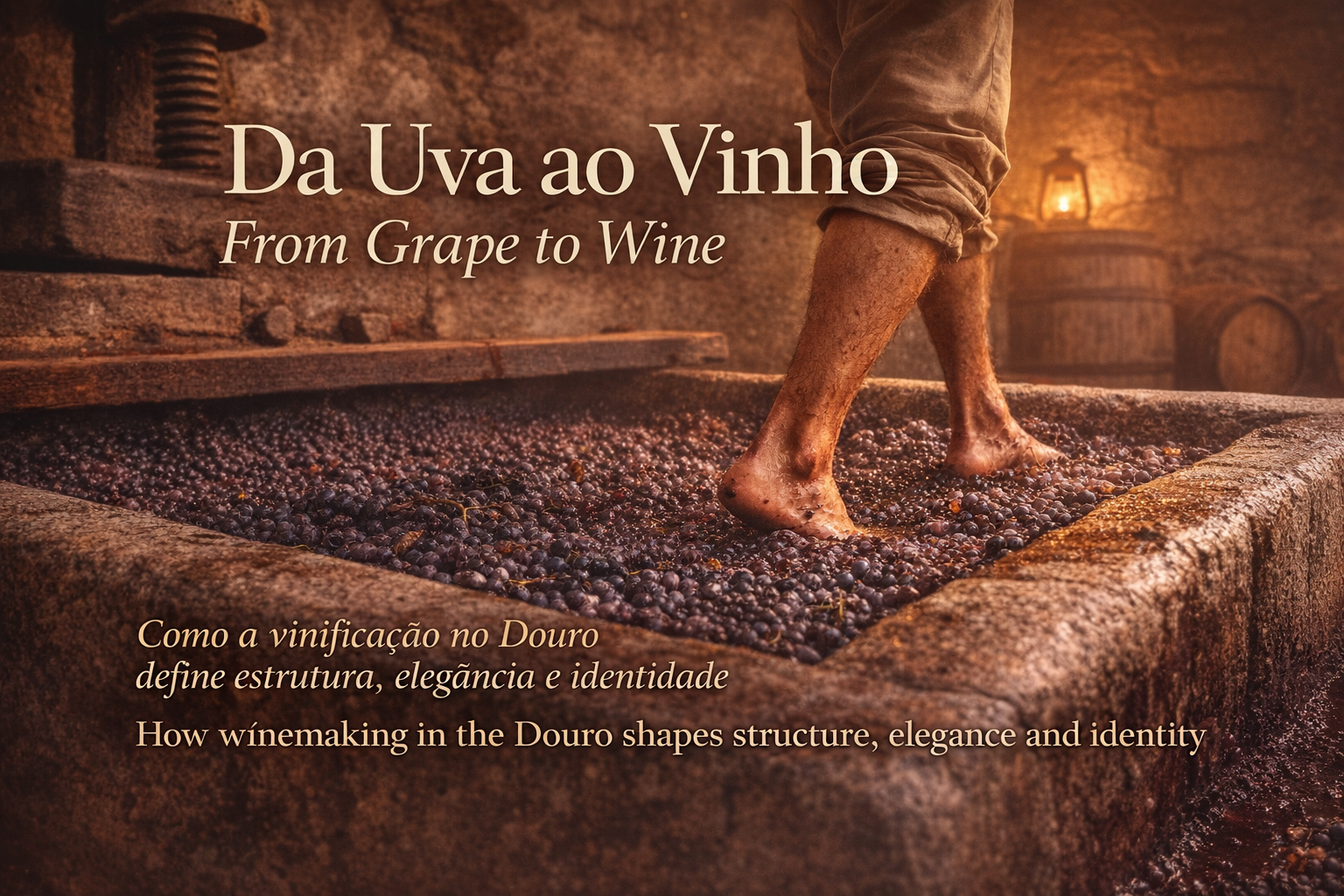
In the Douro, some wineries still use traditional granite lagares where grapes are foot-trodden. This historic method allows gentle and even extraction while preserving seed integrity and avoiding harsh tannins.
Alcoholic fermentation: the birth of wine
Alcoholic fermentation is the moment when grape juice truly becomes wine.
Natural or cultured yeasts transform grape sugars into alcohol, carbon dioxide and a complex array of aromatic compounds.
During this stage, temperature and fermentation time are carefully controlled. Cooler, longer fermentations often preserve aromatic freshness, while warmer fermentations can enhance extraction and structure.
In Douro wines, the challenge is often to balance intensity with elegance.
Maceration and structural development
During and after fermentation, maceration continues to extract phenolic compounds and tannins.
This stage is particularly important for red wines because it defines key elements such as:
- Structure
- Body
- Aging potential
A well-managed maceration can transform a young wine into one capable of evolving for decades.
Pressing and separation
Once fermentation and maceration are complete, the wine is separated from the solid parts of the grape.
Pressing extracts the remaining wine from skins and pulp, often producing different fractions. Some may be more concentrated and structured and are used carefully when blending the final wine.
Aging and development
After fermentation, the wine enters a period of maturation.
Depending on the style desired, this evolution may take place in:
- Stainless steel tanks
- Oak barrels
- Large wooden vats
Aging allows the wine to stabilize and develop new aromatic complexity.
In Douro wines, this stage may reveal notes of spice, ripe fruit, cocoa or subtle oak influence.
When wine finds its identity
Winemaking is a sequence of choices.
Each decision — from grape sorting to aging — shapes the final expression of the wine.
In the Douro, where the terroir already offers intensity and structure, the winemaker’s role is not to dominate nature but to interpret it.
Great wine emerges when vineyard and cellar work in harmony.
And even then, the journey continues.
Because every bottle keeps evolving.
